
 Intelligence. Execution. Advantage.
Your business. Your intelligence. One operating system.
AEGIS OS™ is a custom AI operating system — one governed platform that unifies your people, data, workflows and intelligence around how your business actually works.
The operating layers
Records
One governed record of clients, entities and assets.
Workflow
Execution paths that match how the business runs.
Intelligence
Defined roles working inside set boundaries.
Approval
Human decision points designed into the flow.
Evidence
Attribution and audit trail across every action.
Introducing
AEGIS OS™
- Acquisition
- Evaluation
- Governance
- Intelligence
- Structuring
Your Business Intelligence & Execution OS
AEGIS OS™ brings acquisition, evaluation, governance, intelligence and structuring into one connected operating environment — helping organizations turn information into better decisions and better decisions into execution.
Intelligence. Execution. Advantage.
The category
What is an AI operating system?
An AI operating system is not a chatbot bolted onto your tools. It is the layer your business runs on: one governed platform where records, workflows, AI agents and human approval operate as a single system.
Off-the-shelf AI tools
Generic assistants sit outside your operation. They guess at context, produce output nobody owns, and leave your records, workflows and accountability exactly as fragmented as before.
A custom AI platform
AEGIS OS™ is assembled per organization against your real operating model: your records as the source of truth, your workflows as the execution paths, and intelligence roles that work inside written boundaries with human checkpoints.
That is the difference between adding AI and operating on it — and it is why every AEGIS OS™ build starts with the Architecture Assessment, not a license key.
The problem
Most organizations do not have an intelligence problem. They have an operating problem.
Adding tools to a fragmented operation multiplies the fragmentation. An AI operating system starts with the operating model, then builds intelligence into it.
Work lives in fragments
Critical context sits across inboxes, spreadsheets, drives and point tools, so the same questions get re-answered every week.
No agreed source of truth
Teams operate from different versions of the same record, which makes decisions slower and harder to defend.
Automation without governance
Isolated bots and prompt tools create output nobody owns, reviews or audits.
Execution depends on individuals
Knowledge and follow-through rest with a handful of people rather than the operating system of the business.
Platform architecture
Five layers, one system
AEGIS OS™ is a custom AI platform assembled per organization. The five layers stay consistent; the configuration reflects how your business runs.
- Interface layerDashboards, requests and guided workflows for your team.
- Execution layerGoverned workflows, tasks, approvals and handoffs.
- Intelligence layerModels, prompts, agents and decision logic under policy.
- Truth layerSource-of-truth data, documents and business definitions.
- Governance layerAccess, permissions, audit trail and human accountability.

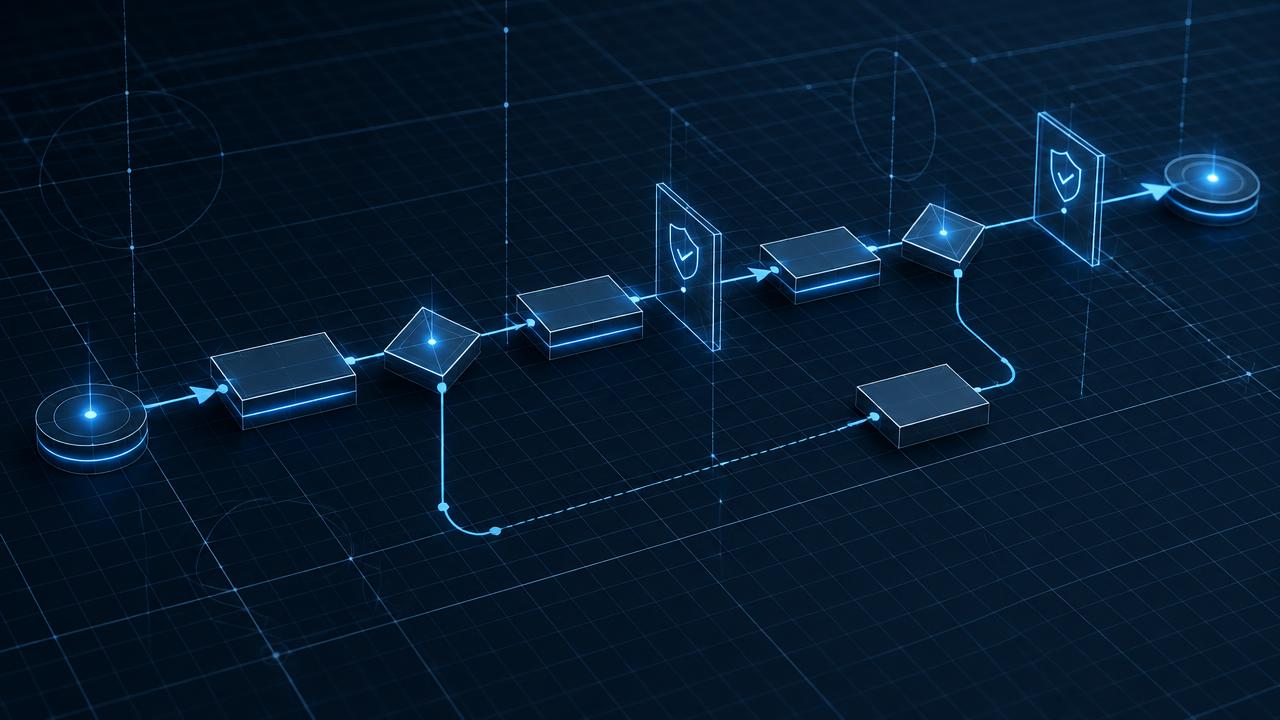
The 7-stage method
From discovery to continuous operation
- 01
Discover
Map how the business actually operates: roles, decisions, systems, bottlenecks and where work stalls.
- Operating model map
- Constraint inventory
- 02
Establish Truth
Define authoritative data, documents and business definitions so intelligence works from one shared record.
- Source-of-truth definitions
- Data and document inventory
- 03
Architect
Design the intelligence, execution and governance layers around your operating model and risk posture.
- System architecture
- Governance model
- 04
Build
Configure workflows, intelligence roles, interfaces and integrations against the approved architecture.
- Configured workflows
- Integration wiring
- 05
Validate
Test against real work and real edge cases with your team, including review, approval and escalation paths.
- Validation results
- Accepted controls
- 06
Deploy
Move into live operation with access control, training and an agreed cutover plan.
- Live deployment
- Enablement and access
- 07
Operate & Improve
Run, monitor and extend the system as conditions change, with defined ownership and review cadence.
- Operating cadence
- Improvement backlog
Solutions
Built for operating realities
- Real EstatePortfolio, pipeline and asset operations.
- Private CapitalFund, investor and capital workflows.
- Business AcquisitionsSourcing, diligence and integration.
- Development & ConstructionProject, vendor and schedule control.
- Healthcare OperationsOperational coordination and oversight.
- Private LendingOrigination, underwriting and servicing.
- Energy & InfrastructureLong-cycle assets and program execution.
- Professional ServicesClient delivery and knowledge operations.
- Travel IndustryAEGIS OS Travel™ — the travel-business operating system.
Front-end applications
Websites and build-outs we design, ship and run
Beyond the operating system, our front-end team designs and builds websites, automation platforms, brand systems, marketing plans and financial models — with a portfolio of live builds you can open yourself.
AI workforce
Intelligence roles that work inside your controls
Defined roles
Each intelligence role has a scope, an owner and a documented set of tasks it may perform.
Human accountability
Review, approval and escalation points are designed in, not added after the fact.
Working from truth
Roles operate against your defined records and documents rather than ad hoc prompting.

Architecture Assessment
Start with a paid diagnostic
The Architecture Assessment is a structured engagement that documents how your organization operates today, defines the target architecture and produces an implementation roadmap and quote. It is the entry point to every AEGIS OS™ build.
- Operating model and constraint mapping
- Source-of-truth and data readiness review
- Target architecture blueprint
- Complexity and readiness analysis
- Phased implementation roadmap
- Architecture-driven quote
Deployments
AEGIS OS™ in the field
AEGIS OS™ is the master platform. The following are AEGIS-powered deployments.
RAW Deal Flow
An AEGIS-powered deployment for deal sourcing and pipeline operations.
RAW Capital Raise
An AEGIS-powered deployment for capital raise workflows and investor operations.
AEGIS OS Travel™
An AEGIS-powered deployment for travel-business operations, delivered on the OdysseySoul deployment environment.
KADAK AEGIS
A licensed enterprise deployment of AEGIS OS™.
Managed Intelligence
A system that keeps working
Deployment is the beginning. Managed Intelligence provides ongoing operation, monitoring, governance review and continued build so the system evolves with the business instead of decaying after launch.
- Operating cadence and system ownership
- Monitoring and issue resolution
- Governance and access review
- Continued workflow and intelligence build
Next step
Turn potential into progress
Start with an architecture call to map your operating model, data reality and execution path.